
Money Talks.
Want to Learn the Language?
Use the filters below to search by type of content and/or topic.

The Cost of Certainty: Why Paying Off Debt Is Rarely Just Math
Paying off debt feels like the obvious win, but it’s rarely just a math question. It turns on the after-tax cost of the debt, the certainty of the alternative return, your liquidity needs, the tax-deductibility of interest, and whether your cash flow can carry it through higher rates. For some, eliminating debt beats any spread. For others, preserving capital is quite rational.

The Conversation We Keep Postponing: Legacy as an Act of Stewardship
Estate planning gets treated as paperwork about death. It is really a series of decisions about control, fairness, and meaning. The structures matter, but research shows most wealth transfers fail on communication and trust, not taxes. A legacy is not what is left behind. It is what is built deliberately and handed on with intention.

Structure Sets the Ceiling: Sophisticated Tax Planning Long Before Tax Season
The largest wealth leak is usually invisible. At scale, tax is not a year-end exercise, it is a design discipline. Structure sets the ceiling of what any plan can deliver, sequence compounds quietly across decades, and policy shifts over time. Real tax efficiency is measured throughout a lifetime, not a single tax year.

The Illusion of the Perfect Entry Point: A Burden of Deployment
A liquidity event transforms how investors behave. The decision of what to do with significant capital suddenly feels immediate and consequential. The real challenge is not timing markets, it is aligning capital with time horizons, liquidity needs, and required returns. Confidence comes from structure, not from finding the perfect entry point.

From Abundance to Uncertainty: The Anxiety of Enough
Wealth can feel uncertain even after success. The shift from earning to relying on a portfolio can change everything. The real question is not “is this enough?” but whether assets, spending, and risk are aligned. Confidence comes not from a number, but from a plan designed to endure.

The Magician’s Trick of Dividend Safety #Why “Income Investing” Feels Safer Than It Really Is
Dividend investing feels safe because the cash is visible. But dividends do not create wealth, they rearrange it. Companies adjust in price, payouts can be cut, and high yield portfolios often hide costly sector bets. Real safety is not a dividend stream. It is total return, diversification, and alignment with your spending needs. Income should be designed, not chased.

How to Sell Your Business
In this episode of Mind Your Money, we sits down with Howard Ma—Director at Baker Tilly Canada Capital and CFA charterholder—to unpack what really happens behind the scenes when a business owner decides to sell.

Average: The Most Dangerous Number in Wealth Management
Averages feel comforting, but in wealth management they often mislead. Markets don’t deliver smooth outcomes, investors rarely earn “average” returns, and retirement spending is uneven across life stages. Wealth is shaped by extremes, not typical numbers. At Westmount Wealth, we plan to lives, using discipline, diversification, and ranges, not averages.
Beyond the Will: Building Leadership for 100-Year Family Enterprises
In this episode, we sit down with Julia Chung, co-founder of Spring Plans and one of Canada’s leading voices in legacy and complex family systems planning. Together, they explore what it means to become a 100-year family—shifting from short-term financial planning to multi-generational leadership and vision.

Beyond Beta: Understanding Risk Through a Planner’s Lens
Risk in investing isn’t one thing, it’s perspective. For Portfolio Managers, it’s numbers: volatility, drawdowns, and betas. For clients, it’s emotion: the fear of plans derailing or goals slipping away. This gap between data and feeling is where true wealth planning lives. At Westmount Wealth, risk is reframed not as something to avoid, but to understand and design around - through diversified behaviors, intentional cash flow structures, emotional guidance, and goal-based framing.

Luck vs. Skill: Rolling the Dice in Asset Management
Can investors reliably identify skilled managers in real time? Evidence suggests not. Studies by Fama and French show that only a few outperform beyond luck, and even then persistence is elusive. SPIVA data confirms most managers lag benchmarks over time. The lesson is clear: focus on controllable factors instead.
Life Insurance to Create Estate Liquidity
In Part 2 of our Death and Taxes series, we unpack the “tax bomb” that often awaits successful business owners and their families—and why traditional estate planning falls short.
Death & Taxes Part 1 - Interview with the Tax Lawyer
In Part 1 of this two-part series, we speak with corporate and tax lawyer Jonathan Wright from Ritchie, Kwo, & Wright LLP, exploring the complex implications of dying while holding private company shares in Canada. They discuss critical issues such as triple taxation risks and explain advanced planning strategies including estate freezes, pipeline planning, and loss carrybacks.

Strategic Tax, Insurance, & Estate Planning in Action
When a high-net-worth family encountered a complex estate tax issue, collaboration became the key to unlocking a powerful solution. Partnering with their tax accountant, our team crafted a creative approach that resolved pressing liquidity concerns and meaningfully reduced the family’s overall tax burden. This case highlights the impact of coordinated advisory efforts in delivering an exceptional outcome.
Don't Let the TOSI Tail Wag the Dog: Income Splitting Insights with @CanadaTaxGuy
In this episode, we sit down with Mohammed Al-khooly, tax expert, Twitter sensation, and co-founder of Copilot Tax, to dive into the world of income splitting. We unpack how TOSI works, who it applies to, and the common pitfalls that business owners face.
Do you Need a Holding Company?
Are you thinking about setting up a holding company? Before you do, tune in to this episode of we sit down with CPA and founder of Simplify Accounting, Shawn Gander, to break down everything business owners need to know about holding companies—what they are when you actually need one, and why too many entrepreneurs set them up for the wrong reasons.

The Tax-Free Savings Account: Don’t judge an account by its name.
The TFSA can be an very powerful tool for wealth generation. Investment income earned inside your TFSA (interest, dividends, and capital gains) do not create an income tax liability. Gains are truly tax-free.
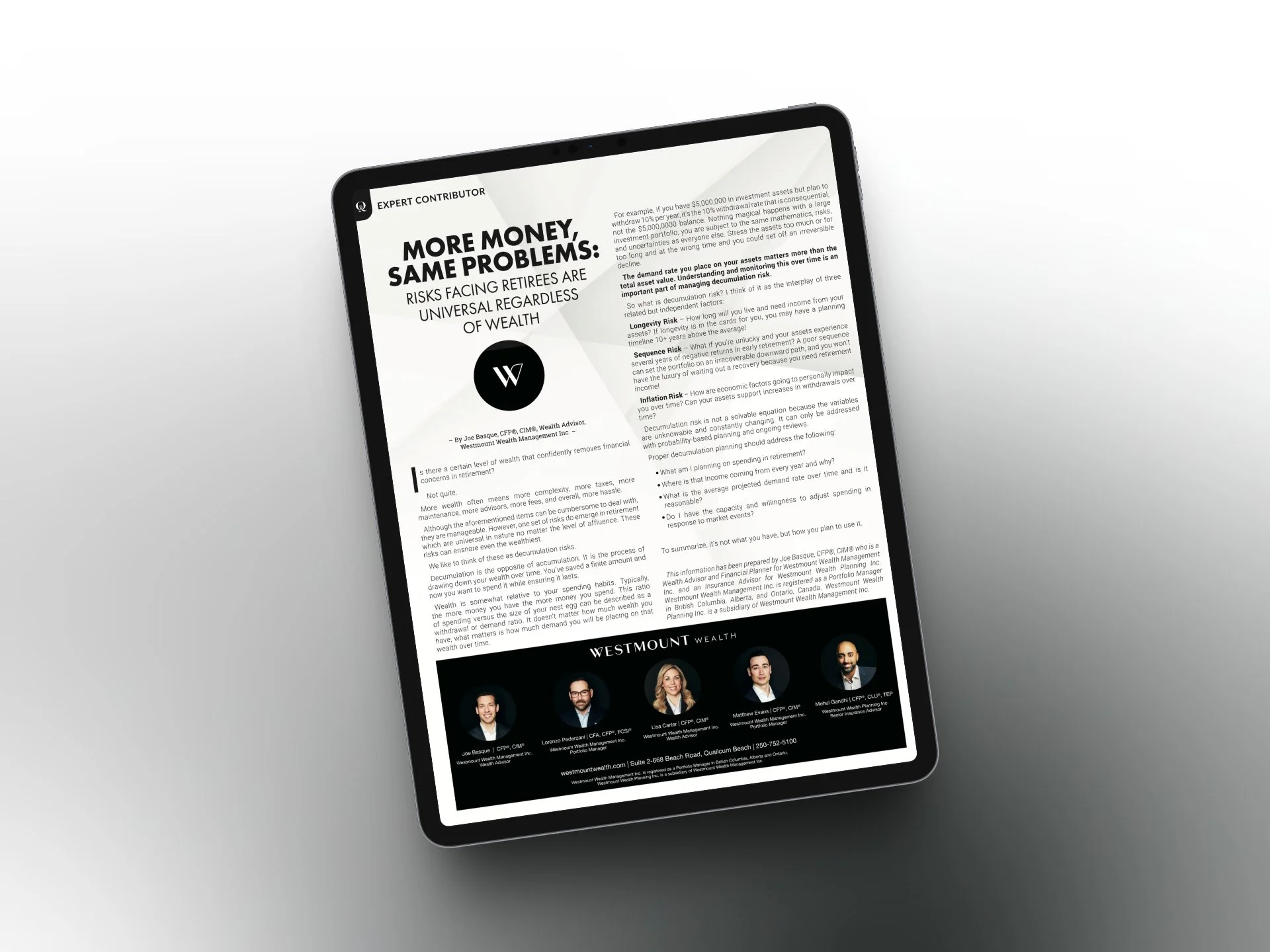
More Money, Same Problems:
More Money, Same Problems: Risks facing retirees are universal regardless of wealth.

Should I add my adult child as a joint owner of my assets?
Several times a year, I receive questions from clients about adding an adult child as a joint owner of their assets. This could be bank accounts, investment accounts, or even as a joint owner of their home.

Wealth Professional: Advisor Feature
Is scrapping DSCs from segregated funds the right path forward?